This is a legacy page. Please click here to view the latest version.
Mon 17 Sep 2018, 12:55 GMT

Penguin orders 16 Enginei fuel management systems


Units to be used aboard a range of new maritime security vessels and multi-role crew boats.


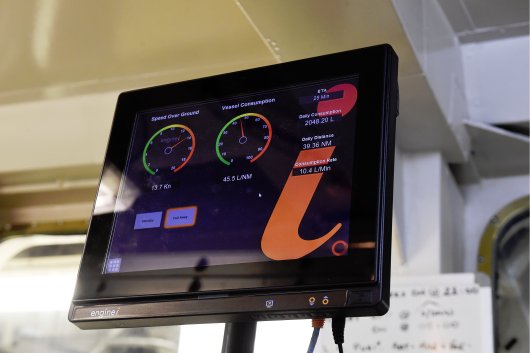
Ecospeed is designed to help ship operators identify and maintain optimum vessel speeds for efficient fuel usage. Its algorithm is based on speed modelling and an analysis of vessel operating data, correlating and synchronising information from different sensors installed on the vessel.
Image credit: Royston Diesel Power
Royston Diesel Power reports that Penguin International Ltd - the Singapore-based designer and operator of aluminium workboats - has ordered 16 of its Enginei electronic fuel management system (EFMS) units for a range of new specialist maritime security vessels and multi-role crew boats.

Penguin, the world's largest builder of mid-sized crew boats, is building several of its flagship Flex Fighter range of high-speed armoured security vessels for anti-piracy operations off the coast of Nigeria.

New Flex-42X multi-role crew boats will also be destined for its own chartering operations in Southeast Asia.

The Enginei systems are being supplied by Royston's local distributors for the Malaya region, CAN Traders and Service Pte. Ltd.

The units, which include Coriolis meters for the main engines and generators, are being installed as part of a comprehensive suite of advanced digital marine technologies, designed to offer enhanced long-term operational safety and efficiency performance.

Greater integration of advanced real-time information tools will be expected to contribute to reducing fuel and operational costs, enabling both the crews and vessel operators to have access to detailed real-time engine performance and other mission-critical information.

Enginei's sensor technology has been specified to accurately monitor engine fuel consumption, which will be tracked against GPS data, voyage details and operational mode.

The data is collected, processed and relayed to bridge and engine room-mounted touchscreen monitors to enable the vessel's master to adjust vessel speed and take whatever other actions are needed to reduce fuel consumption.

Penguin Group's managing director, James Tham, said: "After extensive evaluation, we decided to spec Enginei into our security boats and crew boats as a well-balanced EFMS solution for our owners."

Installation of the Enginei units is being carried out by Penguin's own team of engineers, while CAN Traders is overseeing the commissioning work.

Sean O'Neill, Royston's regional sales manager, noted that the optimisation of fuel use and the minimisation of emissions is an increasingly important issue in the international marine sector.

"We are seeing a lot of interest in our technology from global builders and operators who want to achieve measurable operational and cost savings for their vessels," he said.

According to Royston, Enginei EFMS is compatible with all marine engine types and can be interfaced with newbuild engine installations or retrofitted to operating vessel. Bunker monitoring applications are also available.

Truck-to-ship (TTS) LNG bunkering at Port of Palermo. Molgas completes first LNG bunkering operation at Palermo  

Spanish energy firm carries out maiden LNG delivery at Sicilian port.

Maersk 5,900-teu vessel. Tsuneishi China delivers third methanol dual-fuel boxship in series  

Zhoushan shipbuilder hands over another 5,900-teu Maersk container vessel.

Type approval test (TAT) for ME-LGIA ammonia engine. Everllence completes type approval test for ammonia engine ahead of sea trials  

Eight classification societies oversee testing of ME-LGIA ammonia engine at Copenhagen research centre.

Zhong Ran 23 vessel. CPN bunker barge becomes first vessel listed under Hong Kong’s new quality bunkering scheme  

Zhong Ran 23 achieves listing under the Marine Department’s voluntary mass flow metering initiative.

Peder Moller, Bunker Holding. Bunker Holding posts $73m pre-tax profit amid geopolitical headwinds and board overhaul  

Marine fuels exceeds its own expectations despite 4% revenue decline.

Oilmar Board of Directors graphic. Oilmar formalises governance structure with establishment of board of directors  

Dubai-based marine fuels trader Oilmar appoints three-member board.

Henrik Andersen, Vestas Wind Systems A/S. Vestas Wind Systems CEO appointed vice chair of Bunker Holding  

Henrik Andersen joins the board of the marine fuels group with more than two decades of international business experience.

Tina Revsbech, Maersk Tankers. Maersk Tankers CEO Tina Revsbech joins Bunker Holding board  

Danish USTC Group appoints shipping veteran to subsidiary’s board of directors.

Yampu vessel. CSL delivers world’s first battery-powered self-unloading bulk carrier  

MV Yampu will transport limestone for Adbri in Australia, with full electric operation targeted by 2031.

Illustration of hydrogen fuel cell system. NYK, Yanmar and Eneos to install hydrogen fuel cell system on new Tokyo dining cruise vessel  

Three Japanese companies are collaborating to bring hydrogen propulsion to a dining cruise ship due to enter service in 2027.


↑  Back to Top