This is a legacy page. Please click here to view the latest version.
Fri 17 Aug 2018, 10:06 GMT

Maersk profitability 'significantly impacted' by higher bunker costs


EBITDA negatively affected by bunker price increases not being recovered via freight rates.


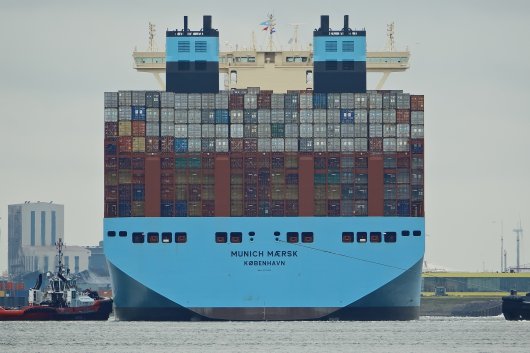
Image credit: Flickr
A.P Moller - Maersk reports that second-quarter (Q2) earnings before interest, taxes, depreciation, and amortization (EBITDA) fell year-on-year (YoY) by 17.7 percent to $883m as EBITDA was negatively impacted by increased bunker costs in its Ocean segment along with a rise in the average bunker price that was said to be equal to $262m in increased cost.

The average price spent on bunkers by Ocean in Q2 was $401 per tonne - a rise of $88, or 28.1 percent, on the previous year, and a quarter-on-quarter (QoQ) increase of $19, or 5.0 percent.

For the first six months (H1), the mean bunker price was $391 per tonne, which was $74, or 23.3 percent, higher than the $317-per-tonne figure recorded in the prior-year period.

The total amount of marine fuel consumed in Q2 increased YoY by 512,000 tonnes, or 20.6 percent, to 3.002m tonnes, whilst in H1 the rise was 1.197m tonnes, or 24.3 percent, to 6.131m tonnes.

The overall spend on marine fuels in Q2 - following Maersk Line's acquisition of Hamburg Sud in November - jumped YoY by $425m, or 54.5 percent, to $1.205bn. In H1, the figure was $2.399bn - an increase of $837m, or 53.6 percent.

Unit cost at fixed bunker price

The unit cost at fixed bunker price in Q2 rose YoY by $51, or 2.9 percent, to $1,783 per forty equivalent unit (FFE), including income from vessel sharing agreements (VSAs).

Maersk explained that, compared to Q2 2017, unit cost at fixed bunker price was 1.4 percent lower after adjusting for negative impacts of 1.8 percent from adverse foreign exchange rate developments and 2.5 percent from changes in portfolio mix following the inclusion of Hamburg Sud.

In a comparison with Q1, the figure was 5.9 percent lower, Maersk noted.

For H1, Ocean posted a YoY rise in the unit cost at fixed bunker price of $99, or 5.7 percent, to $1,837 per FFE.

Total unit cost

The total unit cost for Ocean in Q2 was 6.8 percent higher at $1,961/FFE, compared to $1,836/FFE the year before, negatively impacted by the 28 percent increase in the average bunker price.

Compared to Q1 2018, the total unit cost improved by 5.3 percent.

Ocean EBITDA and revenue

The Ocean division achieved a 25.5 percent increase in Q2 revenue to $6.95bn, up from $5.54bn in the prior-year period. In H1, sales climbed 31.2 percent YoY to $13.76bn.

EBITA, meanwhile, declined YoY by $202m, or 23.1 percent, to $674m in Q2, and by $205m, or 15.1 percent, to $1.16bn in H1.

Maersk's Ocean segment includes the ocean activities of Maersk's Liner Business (Maersk Line, MCC, Seago Line and Sealand) together with Hamburg Sud brands Hamburg Sud and Alianca as well as strategic transshipment hubs under the APM Terminals brand.

A.P. Moller - Maersk results

Maersk posted a Q2 underlying profit of $88m, which was down $117m, or 57.1 percent, on the previous year's figure of $205m. In H1, the Danish firm fell into the red with a loss of $151m, compared to the $66m profit achieved in H1 2017.

Revenue in Q2 jumped $1.82bn, or 23.6 percent, to $9.51bn; in H1, revenue grew $3.97m, or 26.8 percent, to $18.76bn.

EBITDA in Q2 fell YoY by $190m, or 17.7 percent, to $883m, whilst in H1, EBITDA decreased $159m, or 9.3 percent, to $1.55bn.

Impact of higher bunker costs; implementation of emergency bunker surcharge

Maersk explained that the decline in EBITDA was negatively impacted by bunker price increases not being recovered in freight rates and the adverse development in foreign exchange rates.

The shipping group noted that whilst in Q2 the average bunker price was 28 percent higher YoY, the average freight rate in Ocean was 1.2 percent lower.

"Compared to Q1 2018, average freight rate was on par despite the continuing bunker price increases," Maersk pointed out.

Consequently, an emergency bunker surcharge was introduced effective June 1 for unregulated corridors and July 1 for regulated corridors.

"An emergency bunker surcharge was announced in May due to the unsustainable nature of the significant bunker price increases in 2018. Bunker prices reached the highest level since 2014 and the unexpected development prevents recovery of bunker costs through the standard bunker adjustment factors," Maersk stressed.

The impact of the emergency bunker surcharge on average freight rates is expected to be reflected in the H2 2018 results, Maersk said.

Reflections and 2018 guidance

Commenting on the results, CEO Soren Skou remarked: "With revenue up 24% in Q2, we continued to deliver strong growth. The acquisition of Hamburg Sud of course was a positive contributor to growth in our Ocean segment, and we are pleased with the organic growth in non-Ocean. We expect revenue of around USD 40bn in 2018, up almost 50% since 2016. We also delivered a sharp improvement in unit cost in Ocean, after a Q1 that was negatively impacted by inflow of capacity from the acquisition of Hamburg Sud and network issues. Profitability was significantly impacted by higher bunker prices in Q2 and remained at unsatisfactory levels. For the rest of the year we expect improvements in our profitability driven by lower unit cost and higher freight rates."

In its guidance for 2018, A.P. Moller - Maersk said that a $100 change in the price of bunker fuel (net of expected BAF coverage) would lead to the group's EBITDA varying by $0.2bn.

As announced earlier this month, Maersk expects to post an EBITDA in the range of $3.5-4.2bn in 2018 and a positive underlying profit.


Spirit of Mobile vessel. LD Armateurs launches second low-emission ro-ro vessel for Airbus charter fleet  

French shipowner LD Armateurs has launched its second methanol-capable, rotor sail-equipped ro-ro vessel at a Chinese shipyard.

Verde Marine Energy (VME) logo. Verde Marine Energy renews ISCC EU certification and achieves RED III compliance  

Dutch bunker supplier Verde Marine Energy says it is now fully compliant with the EU's updated renewable energy rules.

bound4blue receives DNV Type Approval. Bound4blue wins DNV type approval for its largest installed eSAIL suction sail  

DNV certification of the Model 3-24 eSAIL is said to support wider adoption of wind-assisted propulsion.

BGN and HD HHI signing ceremony. BGN expands owned LPG fleet with two additional VLGCs from HD HHI  

BGN signs a new shipbuilding contract, bringing its owned VLGC fleet to 19 vessels.

Medium-range (MR) tanker with Rotor Sails render. Anemoi and partners win DNV approval in principle for rotor sail integration on MR tankers  

DNV issues approval in principle for EX-rated rotor sail design on medium-range product tankers.

TMS Tankers logo. Lloyd’s Register delivers fleet-wide energy transition roadmap for TMS Tankers  

LR Advisory maps vessel-level compliance risk and decarbonisation pathways across the Greek owner’s tanker fleet.

Dr Prapisala Thepsithar, GCMD. GCMD shares biofuel assurance and green finance insights at Hong Kong shipping decarbonisation forum  

The Global Centre for Maritime Decarbonisation presented pilot findings on biofuels and energy efficiency financing.

Laura Maersk ethanol bunkering graphic. Maersk conducts large-scale ethanol bunkering trial on Laura Maersk in Rotterdam  

A.P. Moller – Maersk has conducted a barge-delivered ethanol bunkering operation as part of ongoing fuel trials.

Luminara vessel truck-to-ship bunkering. MOL Techno-Trade completes first LNG bunkering for international cruise ship in Hokkaido  

Truck-to-ship LNG operation at Hakodate marks first such supply to an international cruise vessel in Hokkaido.

Acta Gemini vessel. Acta Marine takes delivery of methanol dual-fuel CSOV Acta Gemini for RWE wind farm charter  

The vessel will support operations at the Sofia Offshore Wind Farm at Dogger Bank.


↑  Back to Top