This is a legacy page. Please click here to view the latest version.
Fri 4 May 2018, 00:45 GMT

Finnlines orders three hybrid ro-ro ships with scrubbers


Vessels are to use fossil fuel whilst sailing and electricity when in port.


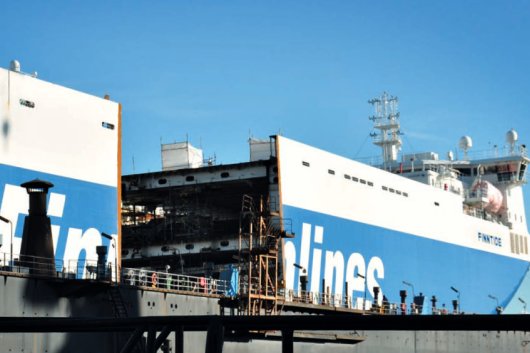
The Finntide was the first of Finnlines' Breeze-class ships to be lengthened at Remontowa shipyard in Gdansk.
Image credit: Finnlines
Finnlines has announced that it has signed an order for three bunker-saving ro-ro vessels that are to be fitted with emission abatement equipment.

The 238-metre-long ships are to be built at the Jinling shipyard in China, with delivery slated from 2020-2021. The total investment is expected to be more than EUR 200 million.

The design of the ships was carried out in cooperation with Nordic marine designer Knud E. Hansen.

According to Finnlines, the ships "will be among the most modern and environmentally friendly vessels in the Baltic". They are to be equipped with latest-generation engines that lower bunker consumption and CO2 emissions, and fitted with scrubbers to abate sulphur emissions and other particulate matter.

The ships will be hybrid ro-ro vessels that use fossil fuel whilst sailing and electricity while in port - hence guaranteeing zero emissions whilst in port.

They will be fitted with a lithium-ion battery bank that can be recharged during sailing and provide the electricity to the ship while at berth.

An air lubrication system under the keel will be used to create bubble layers that reduce friction and hydrodynamic resistance and consequently reduce fuel consumption and emissions as well.

Additionally, Finnlines says the energy efficiency of the ships will be optimised with the hull lines and propellers - including an advanced integrated propeller-rudder system.

Emanuele Grimaldi, CEO of Finnlines, remarked: "These green ro-ro vessels will be built taking all technological and environmental factors into account and thus will increase our energy efficiency further.

"These vessels will offer us the lowest possible fuel consumption and exhaust emissions and again, is in line with our investments in sustainable development.

"We are proud that these exceptional technologies on board will make the vessels the most innovative and efficient vessels in the world."

Zhoushan waterfront at night. Zhoushan becomes world's third-largest bunker port  

Chinese refuelling hub overtakes Antwerp-Bruges and Fujairah to take third place in 2025.

Meyer Turku's net-zero vessel concept render. Meyer Turku completes net-zero cruise ship concept with 90% emissions cut  

Finnish shipbuilder’s AVATAR project vessel design exceeds IMO targets using technologies expected by 2030.

Uni-Fuels Logo. Uni-Fuels renews ISCC certification after first biofuel delivery  

Singapore-based marine fuel supplier completes inaugural ISCC-certified biofuel delivery, supporting EU regulatory compliance.

Close-up of a vessel bow at port. Iberian Peninsula poised to overtake the Netherlands as Europe’s top LNG bunkering hub  

Spanish and Portuguese ports quadrupled ship-to-ship LNG supply in two years, data shows.

FOBAS Fuel Insight Fuel Quality report H2 2025 cover. Lloyd’s Register reports sharp rise in marine fuel quality failures in late 2025  

December recorded the highest monthly off-specification cases, driven by sulphur, catalytic fines and flash point issues.

Bio-LNG bunkering infrastructure. Bahía de Bizkaia Gas launches bio-LNG loading service after ISCC certification  

Spanish regasification terminal begins offering renewable fuel loading for trucks and vessels in January 2026.

Grande Michigan vessel. Grimaldi takes delivery of eighth ammonia-ready car carrier Grande Michigan  

The 9,000-ceu vessel features 50% lower fuel consumption and 5 MWh battery capacity.

Graphic of the ABS logo with a blue background and light effects over a globe. ABS consortium delivers ammonia fuel safety report for EMSA  

Report expands on IMO interim guidelines and highlights need for comprehensive understanding of ammonia properties.

Green Future vessel. NYK operates methanol-fuelled bulk carrier for BHP, claims 65% emissions cut  

Green Future becomes first oceangoing bulk carrier to use low-carbon methanol fuel.

Genesis Sea vessel. Ulstein Verft completes sea trials for Genesis Sea CSOV ahead of spring delivery  

The 89.6-metre vessel features hybrid battery propulsion and preparations for green methanol operation.


↑  Back to Top