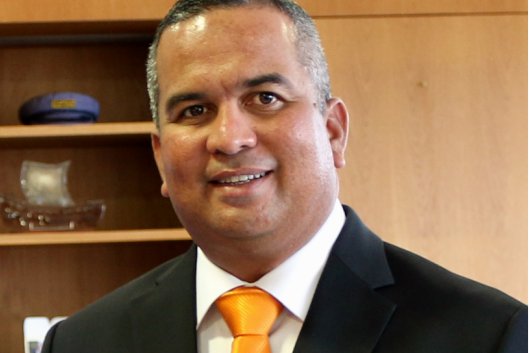
Marshall Islands' environment minister,
David Paul, said on Monday in a statement to the Opening Plenary at this week's 72nd session of the Marine Environment Protection Committee (MEPC) that "the moment of truth has come for the IMO" in terms of regulating greenhouse gas emissions (GHGs).
"The issue
cannot be deferred," he added.
The MEPC is expected to adopt an initial strategy on the reduction of GHG emissions from ships.
The initial strategy will be a framework for member states, which is expected to set out the future vision for international shipping, the levels of ambition to reduce GHG emissions and guiding principles; to include candidate short-, mid- and long-term further measures with possible timelines and their impacts on states as well as identify barriers and supportive measures including capacity building, technical cooperation and R&D.
A draft initial strategy text on reducing GHGs has been presented to this week's MEPC meeting, and Paul admitted on Monday that the text "already represents
significant compromises on our part, and compromises on the part of all countries in this room".
The Marshall Islands minister remarked: "
There are very many things in it we do not like. And things missing from it that we could not even discuss last week". But he was also keen to stress that unless all countries work with the current text as a package, there was a
risk that a consensus may not be reached at all.
"We have all travelled far together. We need to take the final steps. It is time for all those countries who label themselves elsewhere as climate leaders to step up and do what is right," Paul said.
Discussing the draft initial strategy further, Paul warned: "We are willing to work with all countries in this room to improve the text. At the same, I have to be clear that the Marshall Islands, home to the second largest flag registry in the world,
will very publicly dissociate from an outcome from the MEPC that does not contain an explicit quantified level of ambition consistent
with a possibility of achieving the Paris Agreement temperature goals."
Trade-off between climate action and economic growth 'false'
The draft initial strategy text states that
disproportionate negative impacts must be identified and addressed before implementing measures are adopted. But Paul argued that there was "no credible reason to hesitate any longer".
Commenting on the idea of there being a trade-off between climate action and the sustainable economic growth of shipping, the minister was keen to stress that this was "
false".
"I speak with considerable credibility when I say that the argument being presented by some that climate action means a negative impact on shipping and trade is completely and utterly false," he remarked.
"The
technologies exist now to allow shipping to transition to clean and sustainable growth. Industry has clearly stated it wants to act. And so do shipping customers. It needs a clear policy signal from this body to do so." he added.
Paul also argued that the economic impact of higher global temperatures would be far greater than any savings achieved by protecting an industry sector or national economy.
"There will be nothing more devastating to global trade than the cost of having to try to adapt to a world that is on average two, three or four degrees warmer. The costs will dwarf any perceived savings. We do not even know if we can adapt to any scenarios over two degrees. No country will be immune," the minister warned.