This is a legacy page. Please click here to view the latest version.
Thu 5 Apr 2018, 10:07 GMT

IBIA presents best practice guidance for suppliers


New guidance is designed to help assure the quality of bunkers delivered to ships.


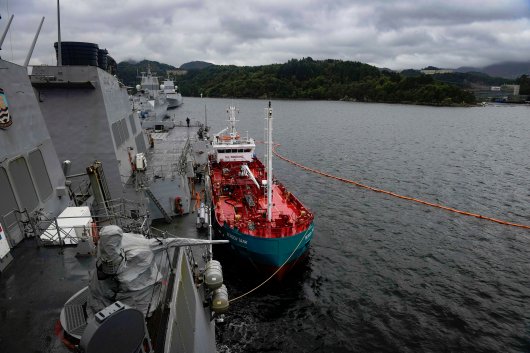
The guided-missile destroyer USS Oscar Austin receives fuel from the tanker Bergen Tank in Bergen, Norway, during a scheduled port visit on August 28, 2017.
Image credit: Flickr
The International Bunker Industry Association (IBIA) has launched the first edition of its 'Best practice guidance for suppliers for assuring the quality of bunkers delivered to ships', which addresses procedures to safeguard and maintain bunker fuel quality control throughout the entire supply chain - from the production of bunkers all the way through to the delivery to ships.

Next week, the 72nd session of the IMO's Marine Environment Protection Committee (MEPC 72) is due to consider the draft best practice guidance for fuel oil purchasers/users, and for fuel oil providers.

The best practice documents are designed to help assure the quality of fuel oil delivered to, and used aboard ships, with respect to both compliance with the MARPOL requirements and the safe and efficient operation of ships.

IBIA contributed to the draft best practice for fuel oil purchasers/users submitted to MEPC 72, and believes its best practice guidance for suppliers will complement it.

The association's best practice guidance for suppliers has drawn on work from a range of experts and international and local standards covering marine fuel oil quality, procedures to maintain quality control in the supply chain, and procedures for delivery to ships and associated sampling and documentation.

IBIA says it has also taken into account commercial realities and the fact that local standards and regulations vary, recognising that the best practice will also be subject to variations.

And whilst IBIA concedes that the guidance is "ambitious" and that "many bunker suppliers would struggle to adhere to various aspects of these best practices", the association stresses that it could help to improve standards and lower the risk of fuel delivered not meeting the buyer's quality specifications.

Call for implementation and feedback

IBIA is now calling on its members to implement the best practices and provide feedback.

"We want to know if the guidance is workable, and what can be improved," IBIA's Unni Einemo explained, adding: "We are open to revising the document in due course in response to constructive feedback and evolving needs."

Issues covered

Elements covered in IBIA's Best practice guidance for suppliers:

- Quality control during production of bunkers
- Quality control in the supply chain
- Cargo transport, storage and transfer
- Delivery to ship (bunkering operations)
- Representative Sampling in the supply chain and during delivery
- Documentation
- Contracting
- Dispute resolution


Graphic promoting Auramarine webinar titled 'Sustainable Fueling Part 3: Ammonia - next alternative fuel in marine'. Auramarine to host webinar on ammonia as marine fuel in April  

Finnish firm will explore ammonia’s role in maritime decarbonisation at its third spring webinar.

Front cover of study by WinGD and Envision Energy titled 'Renewable Fuel Economics: An OPEX illustration based on current costs'. Green ammonia could reach cost parity with VLSFO and LNG by 2050, study finds  

WinGD and Envision Energy study projects green ammonia operational costs competitive with conventional marine fuels.

Elenger Marine's LNG bunkering vessel Optimus alongside Brittany Ferries’ Saint-Malo. Bureau Veritas verifies methane emissions on Brittany Ferries’ LNG vessels  

Verification enables ferry operator to report measured methane slip instead of regulatory default values.

Map showing existing and planned Emission Control Areas (ECAs). Alliance calls for urgent black carbon action as new Arctic emission control areas take effect  

Canadian Arctic and Norwegian Sea ECAs now in force, with compliance deadline set for March 2027.

Artistic impression of battery-electric ferry for operation on Perth’s Swan River. Lloyd’s Register to class Western Australia’s first electric ferry fleet  

Echo Marine Group partners with Lloyd’s Register on five battery-electric ferries for Perth’s Swan River.

Thomas Kazakos, secretary general of The International Chamber of Shipping (ICS). ICS condemns Middle East shipping attacks as 20,000 seafarers remain trapped  

Industry body calls for urgent state action to resupply vessels and enable crew changes.

Molslinjen ferry illustration. Molslinjen order propels Australia to top of battery vessel production rankings  

Danish ferry operator’s three-catamaran order at Incat Tasmania shifts global manufacturing landscape, analysis shows.

Petrobras logo. Petrobras doubles invoiced price of MGO and LSMGO  

Export tax by Brazil's federal government forces Petrobras to double distillate invoice values.

Bunkering of Viking Line's Viking Glory by a Gasum vessel in Turku, Finland. Gasum renews FuelEU Maritime pooling partnerships with Viking Line and Wallenius SOL  

Nordic energy company extends compliance pooling arrangements with two shipping companies operating bio-LNG vessels.

Naming ceremony for CMA CGM Carmen on 18 March 2026. CMA CGM names methanol-powered container ship CMA CGM Carmen  

French shipping line christens 15,000-teu vessel as part of its alternative fuel fleet expansion.


↑  Back to Top