This is a legacy page. Please click here to view the latest version.
Thu 8 Mar 2018, 08:12 GMT

Aegean posts 2017 loss as YoY gross spread plummets


Company sees HEC acquisition as solution to deliver sustainable growth moving forwards.


Aegean Marine Petroleum Network Inc storage tank facility.

Aegean Marine Petroleum Network Inc. reports that it posted a full-year net loss of $29.3 million in 2017, compared to the previous year's net profit of $51.9 million.

Gross profit declined by $63.2 million, or 17.9 percent, to $290.3 million, whilst operating income was $20.1 million compared to the previous year's figure of $94.1 million.

Total revenue generated between January and December amounted to $5,674.3 million, which was a year-on-year (YoY) improvement of $1,598 million, or 39.2 percent.

Sales volume rose slightly during the course of the year by 56,325 tonnes, or 0.34 percent, to 16,575,404 tonnes.

Aegean said the gross spread per metric ton of marine fuel sold fell to $15.8 from $19.5 in 2016, whilst the adjusted earnings before interest, taxes, depreciation, and amortization (EBITDA) per metric tone of marine fuel sold dropped to $3.61 from $8.18 the year before.

Fourth quarter

Aegean recorded a fourth-quarter (Q4) net loss of $28.6 million, compared to the net profit of $16.0 million seen in Q4 2016.

Gross profit fell $31.0 million, or 34.1 percent, to $59.8 million, whilst an operating loss of $16.8 million was recorded in Q4 compared to $24.4 million during the prior-year period.

Revenue in Q4 amounted to $1,365.2 million, which was a YoY increase of $170.2 million, or 14.3 percent.

Sales volume in Q4 declined YoY by 443,677 tonnes, or 11.2 percent, to 3,511,023 tonnes.

The gross spread per metric ton of marine fuel sold fell to $15.5 from $21.1 during the corresponding period in 2016, whilst the adjusted earnings before interest, taxes, depreciation, and amortization (EBITDA) per metric tone of marine fuel sold dropped to -$0.38 from $8.21 the year before.

Management comments

Commenting on the results, Jonathan McIlroy, Aegean's president, said: "We continue to operate in a highly competitive market that remains under significant pressure, which is reflected in our fourth quarter 2017 and full year results. During this period, we have focused on the consistent implementation of our optimization strategy, while simultaneously pursuing new business opportunities to create value and position Aegean for long-term success.

"With uncertainty expected to persist, our board of directors and management took steps to enhance our expense and asset optimization efforts while also enabling Aegean to return to profitable and sustainable growth. The Board unanimously determined that the acquisition of all the outstanding share capital of H.E.C. Europe Limited ('HEC'), a complementary business with high margins, creates a global 'one-stop-shop' for the shipping industry through integrating bunkering and ship waste management. The Board has determined that this transaction is in the best interest of Aegean shareholders and we are confident that with HEC, we can achieve growth significantly greater than what either company could achieve on a standalone basis."

Spyros Gianniotis, Aegean's chief financial officer, remarked: "Our decision to cease operations in Singapore and downsize operations in Fujairah in order to focus on higher return areas contributed to a 15.2 percent decrease in sales volume when compared to the prior quarter. Gross spread per metric ton improved by 6.2 percent from the prior quarter, which reflects our focus on repositioning our portfolio towards higher margin business. Despite recent progress in gross spread improvement, our results are still significantly below the $21.10 level of Q4 2016, indicating that market pressures have not abated. We continue to take steps to right size the business and our financial profile through cost reduction initiatives, and reduced net operating expenses excluding non-recurring items by $2.7 million year-on-year.

"While our recent results show the significant pressures on the markets in which we operate, we remain confident that we are taking the right steps to position Aegean for long-term growth. The acquisition of HEC diversifies the Company's revenue streams, opens up growth opportunities in the environmental services market and creates potential for synergies within our existing network. Once completed, we expect the addition of HEC to be immediately accretive to our operating and financial results and the combined company to accelerate growth moving forward. We will continue our focus on reducing cost, rationalizing and optimizing our presence in key operating hubs and on maximizing asset utilization in order to create value for Aegean shareholders."

Greece 

UEC60LSJ ammonia-fuelled engine render. J-ENG secures orders for four ammonia-fuelled engines under Japanese PCTC project  

Vessels form part of plan to build four ammonia-fuelled car carriers, a dedicated bunkering vessel and supply chain.

Hanwha Power receives ABS AiP for battery-powered containership design. ABS grants AIP to Hanwha Power for 1,700-TEU battery-powered container ship  

Design uses roughly 151 MWh of swappable battery storage for fully electric propulsion on a container vessel.

Peter Krahenbuhl, WinGD. WinGD signs first licence deal with HD Hyundai Marine Engine to expand Korean production  

Mid-bore engine portfolio gains new production route into Korea's bulk carrier and tanker newbuild markets.

ONE Symphony naming ceremony. Ocean Network Express names ammonia- and methanol-ready newbuild ONE Symphony  

Vessel features conventional diesel main engine, with concept designs approved for possible future conversion to methanol or ammonia.

Sing Fuels logo. Sing Fuels seeks Asia-based supply trader to bolster bunker procurement team  

Singapore bunkering firm is recruiting a supply trader to manage marine fuel purchasing across Asia.

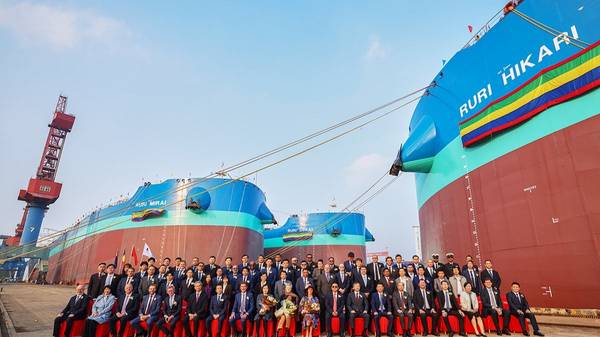
MOL joint naming ceremony. MOL names world's first ammonia-fuelled Capesize bulk carriers  

Naming of Ruri Mirai, Ruri Sekai and Ruri Hikari signals ammonia's arrival as a marine fuel for large bulk carriers.

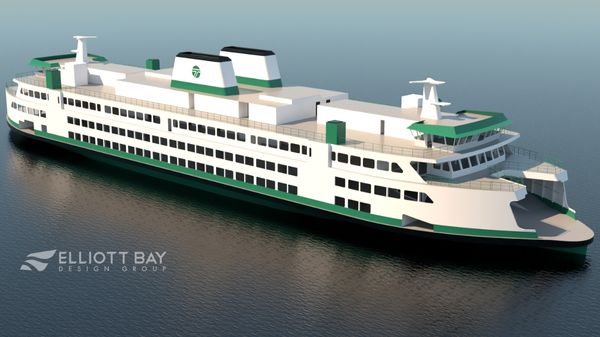
Washington State Hybrid-Electric 160-Auto Ferry vessel render. ABB wins Washington State Ferries' third hybrid-electric vessel order  

ABB extends its role in the US ferry operator's electrification programme, which targets emission-free operations by 2050.

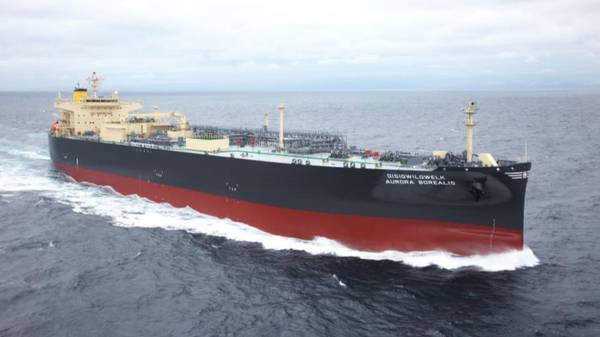
Aurora Borealis vessel. Kawasaki Heavy Industries delivers LPG-fuelled carrier Aurora Borealis  

Ship could also be modified in future to allow for ammonia-fuelled operation.

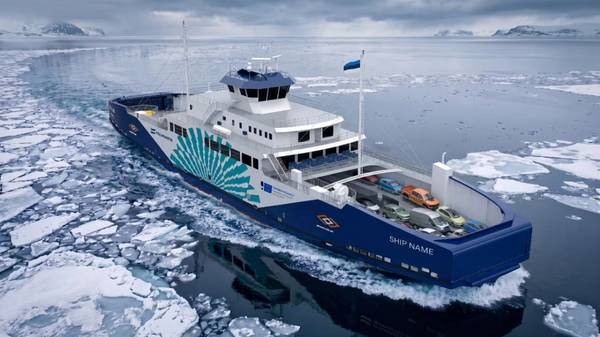
Rendering of Estonia's first shore-charged electric ferry. Estonian State Fleet's shore-charged electric ferry completes model testing in Germany  

Hull and propulsion tests show the vessel's energy consumption remains within contracted limits with room to spare.

Kypros Island vessel. Tsuneishi delivers first methanol dual-fuel Kamsarmax bulk carrier from Chinese yard  

Shipbuilder claims progress towards establishing a mass-production system for vessels designed to reduce environmental impact.


↑  Back to Top