This is a legacy page. Please click here to view the latest version.
Thu 25 Sep 2008, 11:15 GMT

DNV urges owners to be more proactive


Cramer: 'Most companies have not allocated internal resources to optimise fuel consumption'.


Det Norske Veritas (DNV) has urged the shipping industry to be more proactive in their efforts to reduce fuel consumption. In addition to missing out on significant savings opportunities, DNV claims the industry is failing to take advantage of proven systems and routines which will help the industry reduce carbon emissions.

According to an IMO study released earlier this year, annual carbon dioxide emissions released by the global merchant fleet reached 1.12 billion tonnes in 2007, making up about 3.5 percent of total global carbon emissions. Yet a large number of shipowners appear to have continued to operate as normal, despite the looming threat of new IMO legislation on carbon emissions and a corresponding steep rise in the cost of fuel.

According to Dr. Espen Cramer [pictured], head of DNV Maritime Solutions, shipowners have long recognised the business value of reducing fuel consumption, but many have failed to implement more effective and comprehensive energy management strategies.

“The industry’s piecemeal approach to reducing fuel consumption has slowed the efforts of shipowners to make a real difference,” he said.

“Most companies have not allocated internal resources to optimise fuel consumption, lack clear goals and ambitions, fail to communicate their efforts effectively, do not benchmark and report fuel reduction obtained, and many simply outsource the problem to ship managers rather than work with them,” added Cramer.

In 2005, DNV launched its Energy Management service, which it says provides a systematic approach to enable shipping companies to reduce annual expenditure related to fuel and improve their environmental footprint.

This is said to be achieved through improvement identification, solution development for prioritised areas, followed by implementation and monitoring of improved performance. DNV says the implementation of Energy Management also facilitates clear documentation of improved environmental performance, which can deliver a competitive advantage.

“We have identified a fuel saving potential of between five and twenty percent for ships in operation, depending on present performance of the company,” said Cramer. “Yet, the implementation to actually realise this saving potential remains a challenge for many shipowners and ship managers.”

Through three years of experience with Energy Management, DNV claims that it has collected a number of examples of companies which have limited or no knowledge of how effective they are in energy consumption, have no comparison of consumption of individual vessels in their own fleet, or fail to benchmark their progress.

“We also see that many companies start with expensive, costly solutions without first identifying and implementing more cost-effective quick-win solutions.” commented Cramer.

To date, DNV says that it has conducted some 20 fuel efficiency projects where it has helped companies move forward with fuel savings by taking into account both organisational and technological solutions.

DNV has grouped the areas where companies can save fuel into six; -Voyage Performance, which includes optimising voyage planning and weather routing, -Ship Performance, which includes the condition of the hull and propeller and optimising trim and draft, -Bunker Management, which focuses on fuel procurement and management, -Main and Auxiliary engine tuning and optimisation, -Energy Consumers, which includes tank cleaning, thrusters operations, incinerators, and ventilation and HVAC, and -Management & Organisation, which focuses on policy performance management, training and awareness, and following through on environmental issues and planning the total life-cycle of the vessels.

DNV found that fuel costs can account for up to 75 percent of operational costs for container ships. Working with DNV, one major Asian-based container company is said to have achieved annual fuel savings of approximately USD 50 million, and a CO2 emmision reduction of around 300,000 tonnes annually. **While new technologies and systems are being developed, the real challenges facing shipowners cannot be measured in new technologies or training programmes alone. DNV insists that shipowners must learn to think about energy consumption in a new way.

“Energy Management is not rocket science, it’s change management. The companies we work with know their own ships and their own operations much better than we ever will, but where we contribute are in presenting best-industry-practice, structure and facilitate the fuel-reduction programme and ensure benefit tracking and reporting for continued improved performance", said Cramer.

“But for any Energy Management programme to succeed, it must involve people throughout the organisation working together towards a common objective.”

Whilst Cramer says new regulations and an increasingly uncertain global economy characterised by high fuel costs have encouraged shipowners to be more proactive in managing fuel consumption, he remains somewhat surprised by the industry’s effort so far.

“It is rare in this business that such a small investment cost can yield such big results,” he said. “Optimising fuel efficiency is not only a smart business decision and in line with IMO regulations, it’s the right thing to do.”


VPS logo. Fuel quality management for vessels in extended idle: Arabian Gulf, Gulf of Oman and adjacent anchorages | Rahul Choudhuri, VPS  

Managing fuel quality deterioration following the closure of the Strait of Hormuz.

Person signing a document. Agastya Green Fuels signs 250,000 t/yr e-methanol offtake deal with Sri Lanka’s SAR Group  

Indian producer and Sri Lankan maritime firm agree long-term green methanol supply partnership.

Bunker Holding logo. Bunker Holding seeks risk specialist for Copenhagen internal pricing desk  

Danish bunker group is expanding its internal pricing team to meet growing demand for fixed-price solutions.

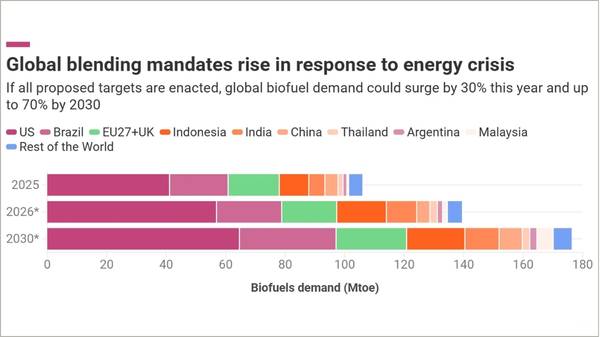
Global biofuels demand chart. Biofuel demand could surge 70% by 2030 as food price fears mount  

T&E warns governments risk trading an oil crisis for a food crisis as biofuel targets strain vegetable oil and fertiliser markets.

Shore power illustration. Shore power shifts from voluntary measure to compliance requirement, DNV white paper finds  

Shore power is moving from an optional emissions tool to a regulatory obligation for shipowners in key trades.

Giosuè Vezzuto and Ahmed Eldemerdash. Baker Hughes’ NovaLT 16 gas turbine receives RINA type approval for marine propulsion on hydrogen and natural gas  

Certification covers operation on natural gas and blends up to 100% hydrogen for marine use.

AiP award ceremony for nuclear reactor integration in cargo vessel design. ABS grants approval in principle for nuclear reactor integration in cargo vessel design  

ABS, HD KSOE, Capital Maritime Group and MIT have received approval in principle for a nuclear-powered cargo vessel propulsion system.

Green e-fuel export corridor consortium partners logos. Green e-fuel export corridor between Brazil and Belgium advances to feasibility stage  

A consortium has been formed to develop a green e-fuel corridor linking Porto do Açu to Antwerp-Bruges.

Naming ceremony of Ocean Express and Ocean Navigator vessels. Sallaum Lines takes delivery of two LNG-fuelled PCTCs in simultaneous handover ceremony  

RoRo carrier receives MV Ocean Express and MV Ocean Navigator from Chinese shipyard.

Person signing a document. Agastya Group signs MoU with Andhra Pradesh government for 1 MTPA green methanol hub at Mulapeta Port  

India-based Agastya Group plans a $6.5bn green methanol export facility on the country's east coast.


↑  Back to Top