Qatargas,
United Arab Shipping Company (UASC) and
Shell have signed a memorandum of understanding (MoU) to explore the development of liquefied natural gas (LNG) as a marine fuel in the Middle East region.
It is the second such agreement signed by Qatargas and Shell in as many months. In February,
a similar MoU was signed between Shell, Qatargas and Maersk.
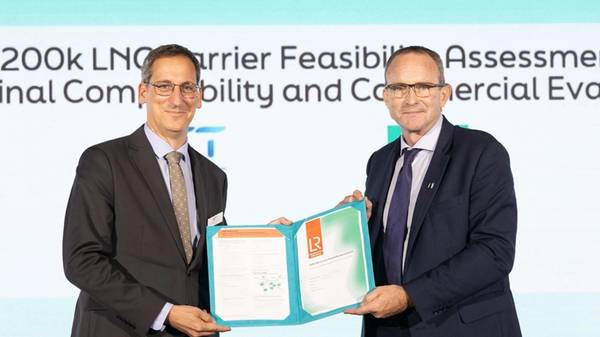
The MOU was signed at a ceremony attended by [pictured from left to right]
Jørn Hinge, UASC CEO;
Khalid Bin Khalifa Al-Thani, Qatargas CEO; and
Michiel Kool, Director and Chairman of Qatar Shell Companies.
Through the joint relationship, the partners are to explore the development of new markets for LNG to be used as propulsion fuel within the Middle East Region and the conversion of UASC's existing vessels to cleaner fuel.
The MOU envisages LNG supplies for this initiative to be made available from
Qatargas 4, a joint venture between Qatar Petroleum and Shell Gas B.V., with United Arab Shipping Company Line potentially using the fuel for its recently built container ships.
Commenting on the MoU, Saad Sherida Al-Kaabi, Chairman of Qatargas Board of Directors, said: “LNG as a marine fuel is gaining momentum in the deep sea transportation industry as the best alternative to meeting increasing environmental standards."
"This agreement between Qatargas, Shell and United Arab Shipping Company demonstrates our commitment to building LNG fueled vessels and the supply system to support it. Further to our commitment to pioneering new LNG applications and in preparation to fulfilling any upcoming regulatory requirements, we believe that this direction by Qatargas and its industry partners is the right path to support a cleaner environment."
Khalid Bin Khalifa Al-Thani, Qatargas Chief Executive Officer, remarked: "Qatargas is pleased to be a partner with Shell and UASC in this second MOU for LNG as a Marine Fuel. LNG as a transportation fuel is growing and we with our partners believe we have the people, tools and resources to make it a reality. Through this effort we know we can make a significant impact on how the shipping industry evolves over the next generation. We see this as our opportunity to support the international efforts to reduce greenhouse emissions and create a cleaner environment for future generations."
Jorn Hinge, United Arab Shipping Company Group Chief Executive Officer, said: "UASC, with Shell and Qatar Gas, is fully committed to environmental sustainability and developing LNG as a marine fuel. As part of our newbuilding program, UASC has received thirteen of seventeen new vessels over the past sixteen months; seven 15,000 TEU vessels and six 18,800 TEU ultra-large container vessels. We are due to take delivery of a further four 15,000 TEU vessels in the coming months. These ships are the greenest in the world and uniquely LNG-ready, meaning once the infrastructure is ready globally, with a quick and cost-efficient retrofit, they can run on LNG and become even more eco-friendly.
"We have seen an increased demand on green shipping from our customers in recent years and a focus on how the eco-efficient technologies on our new vessels can help them achieve their own sustainability strategy. Stricter environmental regulations are also expected, something we are well prepared for. Many organizations have already included stricter requirements in their tenders and evaluation criteria, meaning only those carriers with optimum environmental credentials will qualify or be shortlisted."
Michiel Kool, Managing Director and Chairman of Qatar Shell Companies said: "Shell is delighted to work in partnership with Qatargas and United Arab Shipping Company to create new market development opportunities for the use of LNG as a marine fuel in the Middle East region from its Qatargas 4 venture. Shell has been a pioneer in this area with our investments in LNG for transport infrastructure in Europe and the US, and we look forward to now deploying our expertise to create a regional hub in the Middle East in collaboration with two very strong global partners based in the region, Qatargas and United Arab Shipping Company."
Image: From left to right: Jorn Hinge, UASC CEO; Khalid Bin Khalifa Al-Thani, Qatargas CEO; and Michiel Kool, Director and Chairman of Qatar Shell Companies.