This is a legacy page. Please click here to view the latest version.
Wed 30 Jul 2008, 08:04 GMT

Valero Q2 profit drops by 67 percent


US refiner cites tight refining margins and the rising cost of crude oil.


San Antonio-based Valero Energy Corporation has announced its second quarter profit fell by 67 percent as the cost of crude oil outpaced the price of gasoline.

The United States' largest oil refiner said second-quarter net income for the three months ended June 30th dropped to $734 million, or $1.37 a share, from $2.25 billion, or $3.89 a share in the same period a year ago.

Revenue rose to $36.6 billion from $24.2 billion in the prior-year period.

The company's results were higher than Wall Street forecasts, which had expected a profit of $1.33 per share on average, and revenue of $34.93 billion.

Refining margins fell markedly in the second quarter as the cost of crude and other feedstocks grew more rapidly than the price of fuel oil, gasoline, asphalt and other products.

The company noted that the average price of the benchmark West Texas Intermediate(WTI) crude nearly doubled to $123.98 per barrel in the last quarter from $64.89 per barrel a year ago. Meanwhile, benchmark Gulf Coast gasoline margins decreased by 77 percent during the same period, from $28.95 per barrel in the second quarter of 2007 to $6.60 per barrel in the second quarter of 2008.

Partially offsetting these weaker margins were significantly higher margins on distillate products such as diesel and jet fuels, which continued to experience strong global demand, and improved differentials for sour crude oil.

At the same time, Valero's operating income was squeezed by higher costs for electricity and natural gas. Operations were also hampered by maintenance work and repairs carried out at its refineries in Aruba, Port Arthur, Delaware City and Texas.

"Despite the difficult environment for margins on gasoline and many secondary products, Valero continued to be profitable," said Bill Klesse, Valero's Chairman of the Board and Chief Executive Officer. "Wide differentials for the heavy and sour feedstocks that we can process in our refineries benefited us significantly in the second quarter.

"In our refining operations, we've made great progress in shifting production to take advantage of the strong market for distillates. From 2008's first quarter to the second quarter, we increased our distillate production by 110,000 barrels per day while maintaining steady gasoline production. In the same time frame, we increased our use of discounted feedstocks from 66% to 68%, partially due to improved operations at our heavy sour refineries where we completed a major turnaround at Delaware City, finished our coke drum repair at Port Arthur, and repaired the vacuum tower at our Aruba refinery," added Klesse.

Klesse said Valero expects distillate margins to remain strong for the rest of this year and next, but predicts gasoline margins will continue to be weak and industry utilization rates will decline. The company expects secondary products to have a margin recovery, particularly if the price of crude oil stabilizes or falls, as the prices of these products lag changes in the price of crude oil.


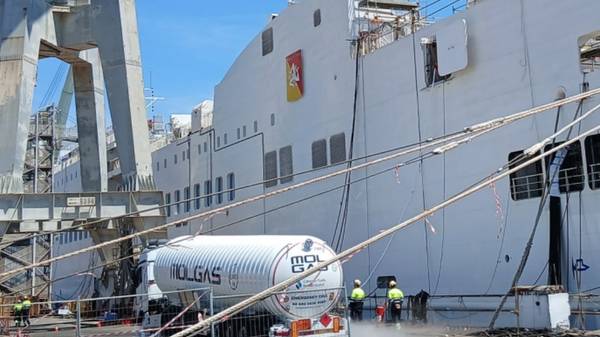
Truck-to-ship (TTS) LNG bunkering at Port of Palermo. Molgas completes first LNG bunkering operation at Palermo  

Spanish energy firm carries out maiden LNG delivery at Sicilian port.

Maersk 5,900-teu vessel. Tsuneishi China delivers third methanol dual-fuel boxship in series  

Zhoushan shipbuilder hands over another 5,900-teu Maersk container vessel.

Type approval test (TAT) for ME-LGIA ammonia engine. Everllence completes type approval test for ammonia engine ahead of sea trials  

Eight classification societies oversee testing of ME-LGIA ammonia engine at Copenhagen research centre.

Zhong Ran 23 vessel. CPN bunker barge becomes first vessel listed under Hong Kong’s new quality bunkering scheme  

Zhong Ran 23 achieves listing under the Marine Department’s voluntary mass flow metering initiative.

Peder Moller, Bunker Holding. Bunker Holding posts $73m pre-tax profit amid geopolitical headwinds and board overhaul  

Marine fuels exceeds its own expectations despite 4% revenue decline.

Oilmar Board of Directors graphic. Oilmar formalises governance structure with establishment of board of directors  

Dubai-based marine fuels trader Oilmar appoints three-member board.

Henrik Andersen, Vestas Wind Systems A/S. Vestas Wind Systems CEO appointed vice chair of Bunker Holding  

Henrik Andersen joins the board of the marine fuels group with more than two decades of international business experience.

Tina Revsbech, Maersk Tankers. Maersk Tankers CEO Tina Revsbech joins Bunker Holding board  

Danish USTC Group appoints shipping veteran to subsidiary’s board of directors.

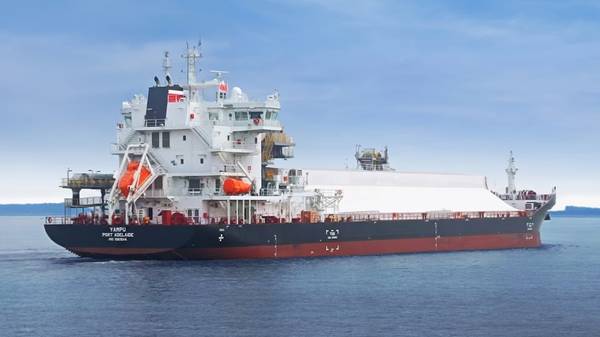
Yampu vessel. CSL delivers world’s first battery-powered self-unloading bulk carrier  

MV Yampu will transport limestone for Adbri in Australia, with full electric operation targeted by 2031.

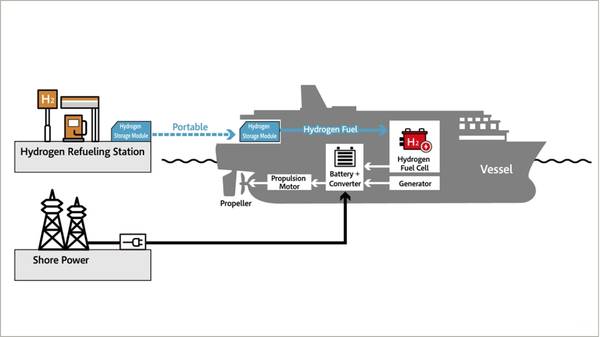
Illustration of hydrogen fuel cell system. NYK, Yanmar and Eneos to install hydrogen fuel cell system on new Tokyo dining cruise vessel  

Three Japanese companies are collaborating to bring hydrogen propulsion to a dining cruise ship due to enter service in 2027.


↑  Back to Top


 Recommended