This is a legacy page. Please click here to view the latest version.
Wed 11 Jun 2008, 08:40 GMT

Emissions forum takes place in Dubai


UAE event tackles topic of shipping emissions and energy efficiency.


Maritime classification society and service company Germanischer Lloyd(GL) conducted its first Exchange Forum in Dubai this week. The event, which dealt with shipping emissions and energy efficiency, was attended by a large number of representatives from the local maritime industry in the UAE: shipping companies, ship management agencies and shipyards.

Organised by GL Office Dubai, the Forum highlighted the current status of emission control in respect to Sulphur-oxide emissions (SOx) Nitrogen-oxide emissions (NOx) and Carbon-dioxide emissions (CO2).

The main speaker at the event was Dr Pierre C. Sames, Director Strategic Research and Development of Germanischer Lloyd. He gave an overview regarding “Ship emissions – status and challenge ahead” in which he underlined the necessity of the International Maritime Organization (IMO) to obtain an international agreement on further reduction of ship related emissions to air. While SOx and NOx emissions have a strong impact on coastal regions, CO2 emissions pose a global challenge. Given the expansion of the world fleet, reducing air emissions has a high environmental priority for the shipping industry.

In respect to CO2 emissions, Germanischer Lloyd has developed an operational CO2-index for shipping. It is based on the forthcoming IMO requirements and allows each ship owner and ship management company to get an overview of the amount of CO2 emissions being released by each ship.

In 2003, the United Nations Framework Convention on Climate Change (UNFCCC) tasked the IMO to initiate developments related to the reduction of greenhouse gas emissions from ships. The assembly of the IMO adopted this in a resolution. In 2005, IMO's Marine Environment Protection Committee (MEPC) completed an interim guideline on operational CO2-indexing, as a first step towards measuring the CO2-emissions from international shipping.

Today, the operational index is considered to be one element of a package of measures that will eventually facilitate CO2 emission reductions from shipping. Although shipping is one of the smaller contributors to global CO2 emissions, the inclusion of maritime transport in a future emission control regime is currently under discussion at international political levels and is assumed to become reality after 2012.

According to Pierre Sames, the implementation of the operational CO2 index is one step to consistently reduce CO2 emissions. It is considered as a future link towards market-based instruments like an emission certificate trading system.

The new CO2-index tool can be already used to record fuel consumption, the amount of cargo and the distance between two consecutive ports. With carbon emission factors specified by the IMO, the operational CO2-index is calculated for each voyage. After a year, all the data collated for a ship and its sister vessels are averaged.

A GL surveyor will then check the recorded data and eventually issue a certified operational CO2-index on behalf of a flag state. Applied on several ships of a fleet, it enables a comparison of CO2-indices to take place. This function in particular is expected to trigger a learning effect as differences in fuel consumption will be made explicit and more transparent with the data associated to each vessel and voyage segment.

With certified CO2-index values becoming public, the transport industry will then be able to actively minimize emissions. Ships with a low index will transport more cargo and improve their index even further.

In his second presentation, Pierre Sames focused on the broad range of topics related to ship efficiency, an area closely related to the reduction of air emissions.

The key issues were identified as being the efficient design, construction and operation of ships that are profitable and environmentally compatible.

“Today, each ship owner is interested to reduce fuel consumption of his ships. The fuel costs for a series of eight container ships over 25 years are 8.8 billion US-Dollars on current prices. It makes a lot of sense to invest in ship efficiency,” said Sames.

He pointed out, that a lot can be done for newbuildings. Design measures include optimized hull forms and hull structure, air cushions, improved inflow onto the propeller and enhanced engine efficiency. For existing ships operative measures can apply to coating types, the performance of the crew, the management of the energy on board, reducing speed as well as an optimized load factor.

Sames concluded that in the long run, alternative fuels would need to be examined. He analysed the potential of gas-fuelled ships which would be a step towards the implementation of fuel cell systems. At the end of the forum he concluded “With ever rising fuel prices, ship efficiency is the key to economic shipping.”


TMS Tankers logo. Lloyd’s Register delivers fleet-wide energy transition roadmap for TMS Tankers  

LR Advisory maps vessel-level compliance risk and decarbonisation pathways across the Greek owner’s tanker fleet.

Dr Prapisala Thepsithar, GCMD. GCMD shares biofuel assurance and green finance insights at Hong Kong shipping decarbonisation forum  

The Global Centre for Maritime Decarbonisation presented pilot findings on biofuels and energy efficiency financing.

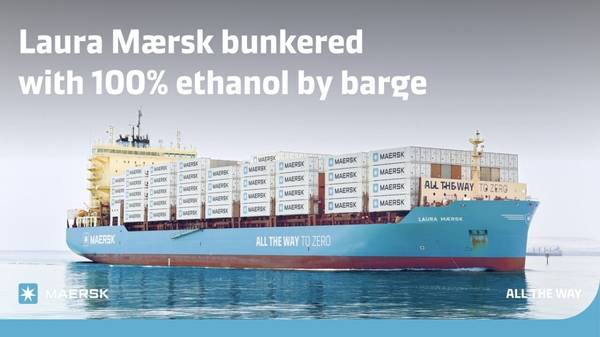
Laura Maersk ethanol bunkering graphic. Maersk conducts large-scale ethanol bunkering trial on Laura Maersk in Rotterdam  

A.P. Moller – Maersk has conducted a barge-delivered ethanol bunkering operation as part of ongoing fuel trials.

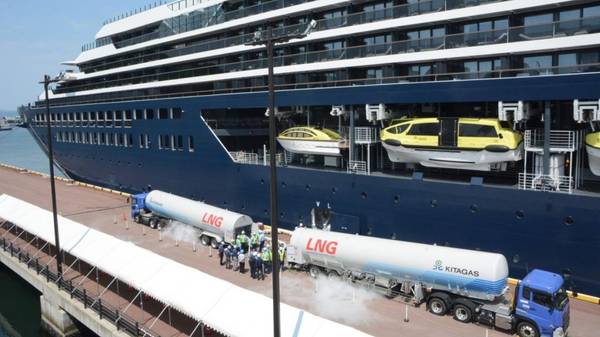
Luminara vessel truck-to-ship bunkering. MOL Techno-Trade completes first LNG bunkering for international cruise ship in Hokkaido  

Truck-to-ship LNG operation at Hakodate marks first such supply to an international cruise vessel in Hokkaido.

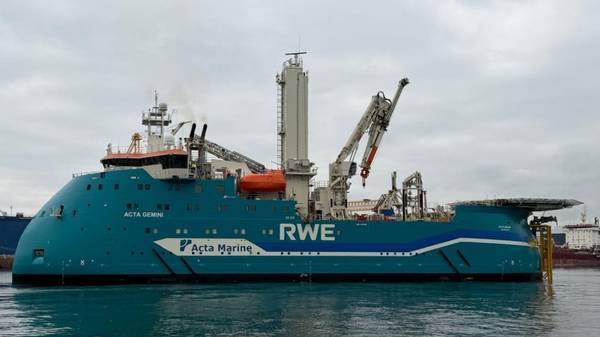
Acta Gemini vessel. Acta Marine takes delivery of methanol dual-fuel CSOV Acta Gemini for RWE wind farm charter  

The vessel will support operations at the Sofia Offshore Wind Farm at Dogger Bank.

Yeva Wood and Kirsten Møller Jørgensen. Malik Supply expands Danish team with bunker trader and finance hire  

Danish bunker supplier Malik Supply adds two new staff across its Fredericia and Aalborg offices.

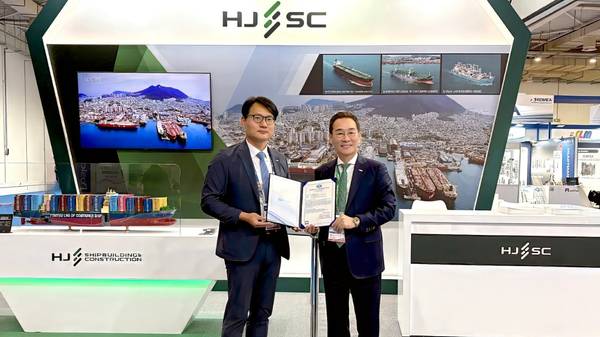
AiP award ceremony for a 10,000-teu biofuel-powered container ship. HJSC wins AiP for 10,000-teu biofuel-powered container ship design  

South Korean shipbuilder HJ Shipbuilding & Construction receives classification society approval for its biofuel vessel design at Posidonia.

Active vessel. Capital Clean Energy Carriers takes delivery of LNG carrier and dual-fuel gas carrier, secures five new charters  

Athens-based CCEC expands its fleet and pushes contracted revenue backlog to $3.1bn.

VPS logo. Fuel quality management for vessels in extended idle: Arabian Gulf, Gulf of Oman and adjacent anchorages | Rahul Choudhuri, VPS  

Managing fuel quality deterioration following the closure of the Strait of Hormuz.

Person signing a document. Agastya Green Fuels signs 250,000 t/yr e-methanol offtake deal with Sri Lanka’s SAR Group  

Indian producer and Sri Lankan maritime firm agree long-term green methanol supply partnership.


↑  Back to Top