Five large containerships of Greek shipping company
Costamare will be the first worldwide to operate in full compliance with MEPC / circ. 471 of IMO regarding operational CO2 indexing.
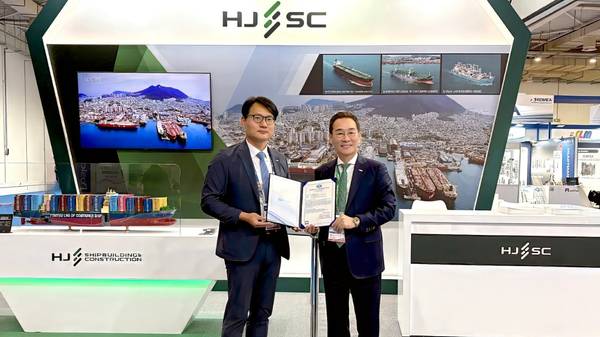
Costamare has registered the vessels COSCO Guangzhou, COSCO, Ningbo, COSCO Yantian, COSCO Beijing and COSCO Hellas with Germanischer Lloyd’s operational CO2 indexing program. On the basis of consumed fuel, transported cargo and distance sailed, CO2 emissions are to be determined using Carbon emission factors. Computed index values can be compared to sister ships’ indices and eventually be used to minimise emissions from transport. The agreement was signed at the Posidonia Exhibition between
Costis V. Constantakopoulos, CEO of Costamare Shipping, and Dr.
Hermann J. Klein, Member of the Executive Board Germanischer Lloyd.
“With the realisation of an operational CO2 emission indexing for ships, Germanischer Lloyd contributes significantly to the future wide implementation of such an index”, said Dr. Klein. “We are glad that Costamare Shipping is a leader in gaining widespread experience with the CO2 indexing methodology in general.”
With the implementation of the operational CO2 index on five ships, Costamare - Greece’s largest containership operator - has sought to demonstrate its commitment to environmental protection. According to the company, the implementation of the operational CO2 index is an important step towards consistently reducing CO2 emissions. Applied on several ships of a fleet, it allows a comparison of CO-indices. This function is expected to trigger a learning effect as differences in fuel consumption will be made explicit and more transparent with the data associated with each vessel and voyage segment.
The new CO2-index tool by GL can be used today to record fuel consumption, transported cargo and distance between two consecutive ports. With carbon emission factors specified by IMO, the operational CO2-index is calculated for each voyage and later averaged for a defined period, usually a year. At the end of the period, a GL surveyor will check the recorded data and eventually issues a certified operational CO2-index which is then valid for the next period.
In 2003, the
United Nations Framework Convention on Climate Change (UNFCCC) tasked IMO to initiate developments related to the reduction of green house gas emissions from ships. The assembly of IMO adopted this in a resolution. In 2005, MEPC completed an interim guideline on operational CO2-indexing, as a first step towards measuring the CO2-emissions from international shipping.
Today, the operational index is considered to be one element of a package of measures to eventually facilitate CO2-emission reductions from shipping. It is also considered to be a future link towards market-based instruments like an emission certificate trading system.