This is a legacy page. Please click here to view the latest version.
Mon 7 Apr 2008, 08:17 GMT

MEPC approves reduction in sulphur emissions


IMO Committee decides on progressive reduction of global sulphur cap and new limits in SECAs.


The Marine Environment Protection Committee (MEPC) of the International Maritime Organization (IMO) has approved proposed amendments to the MARPOL Annex VI regulations to reduce harmful emissions from ships.

The main changes would see a progressive reduction in sulphur oxide (SOx) emissions from ships, with the global sulphur cap reduced initially to 3.50% (from the current 4.50%, effective from 1 January 2012; then progressively to 0.50 %, effective from 1 January 2020, subject to a feasibility review to be completed no later than 2018.

The limits applicable in Sulphur Emission Control Areas (SECAs) would be reduced to 1.00%, beginning on 1 March 2010 (from the current 1.50 %); being further reduced to 0.10 % , effective from 1 January 2015.

Speaking at the close of MEPC, IMO Secretary-General Efthimios E. Mitropoulos said "The fact that representatives of some 100 Governments were able to reach decisions by consensus on complicated issues of great importance to the environment not only bears testimony to the responsible manner with which the Members address environmental matters nowadays but also to the great results that can be achieved when States, with the same concerns and determination to produce meaningful solutions to global problems, work together under the auspices of IMO. The co-operation of the shipping industry and environmentalist groups has been of great value and I thank them for that.

"I am confident that, once adopted as amendments to MARPOL Annex VI, the new measures will prove extremely beneficial to the environment and I commend the Committee wholeheartedly for its achievement in developing them. It will certainly be one of IMO's finest hours when this happens six months from now".

Mitropoulos also commended the progress in work on greenhouse gas emissions (GHG) from shipping operations, including the search for practical means to devise any mechanisms deemed appropriate to address this issue. He welcomed the MEPC's endorsement of his proposal to expedite the Organization's related work, in particular, as regards the CO2 Emission Indexing Scheme and the CO2 Emission baseline(s).

The proposed draft amendments to Annex VI and the NOx Technical Code will now be submitted to MEPC 58 (which meets from 6 to 10 October 2008) for adoption, in accordance with an agreed timetable. This would see the revised Annex VI enter into force in 2010. The work on greenhouse gases is scheduled for completion in 2009, in time for IMO to submit a position paper to the Copenhagen Conference in December 2009.

The Working Group on GHG Emissions from Ships developed practical next steps covering the development of short-term and long-term measures to address CO2 emissions from ships. The next steps were approved by the MEPC.

Short-term measures include a proposal to establish a global levy scheme on marine bunker fuel to achieve GHG emission reductions. Under this scheme, all ships engaged in international voyages would be subjected to a bunker levy established at a given cost level per ton of fuel bunkered. With such a scheme in place, a baseline of fuel used and CO2 emissions would be obtained.

The prospect of a global levy/credits scheme contributing to a GHG emissions reduction from ships was found promising, although it was noted that several aspects would need to be clarified and worked on, including:

• The practical implementation of a global levy scheme;
• Who would collect the levies and how;
• How would the revenues be distributed;
• The relation with existing environmental levies and tax regimes in general;
• Would there be enough Clean Development Measures1 to buy with the credits; and
• The potential for a modal shift in transport at the regional level.

Other short-term measures listed for further consideration include:

• Improvement of specific fuel consumption;
• Energy Efficiency Design and Management Plan/Using a Test Mode for estimating CO2-index of new-build ships;
• Onshore power supply;
• Use of wind power;
• Voluntary/mandatory requirements to report CO2 index values, information exchange/outreach and rating
• Strict limitations on leakage rates of refrigerant gases;
• Vessel speed reductions;
• Measures to improve traffic control, fleet management, cargo handling operations and energy efficiency.

The MEPC endorsed the view of the Working Group that a resolution (to be adopted by the MEPC and/or Assembly), should be developed at an intersessional meeting of the GHG Working Group to be held in Oslo, Norway, from 23 to 27 June 2008.

The longer-term measures identified by the Working Group and approved by the Committee for further development include:

• Technical measures for ship design;
• Use of alternative fuels
• A CO2-Design Index for new ships;
• External verification scheme for CO2 operational index;
• Unitary CO2 operational index limit, combined with penalty for non-compliance;
• Emissions Trading Scheme (ETS) and/or Clean Development Mechanism (CDM); and
• Inclusion of mandatory CO2 element in port infrastructure charging.

Other measures to reduce GHG emissions from ships will be considered by the Intersessional Correspondence Group on Greenhouse Gas Emissions from Ships, which was will to report to the MEPC at the 58th session.


TMS Tankers logo. Lloyd’s Register delivers fleet-wide energy transition roadmap for TMS Tankers  

LR Advisory maps vessel-level compliance risk and decarbonisation pathways across the Greek owner’s tanker fleet.

Dr Prapisala Thepsithar, GCMD. GCMD shares biofuel assurance and green finance insights at Hong Kong shipping decarbonisation forum  

The Global Centre for Maritime Decarbonisation presented pilot findings on biofuels and energy efficiency financing.

Laura Maersk ethanol bunkering graphic. Maersk conducts large-scale ethanol bunkering trial on Laura Maersk in Rotterdam  

A.P. Moller – Maersk has conducted a barge-delivered ethanol bunkering operation as part of ongoing fuel trials.

Luminara vessel truck-to-ship bunkering. MOL Techno-Trade completes first LNG bunkering for international cruise ship in Hokkaido  

Truck-to-ship LNG operation at Hakodate marks first such supply to an international cruise vessel in Hokkaido.

Acta Gemini vessel. Acta Marine takes delivery of methanol dual-fuel CSOV Acta Gemini for RWE wind farm charter  

The vessel will support operations at the Sofia Offshore Wind Farm at Dogger Bank.

Yeva Wood and Kirsten Møller Jørgensen. Malik Supply expands Danish team with bunker trader and finance hire  

Danish bunker supplier Malik Supply adds two new staff across its Fredericia and Aalborg offices.

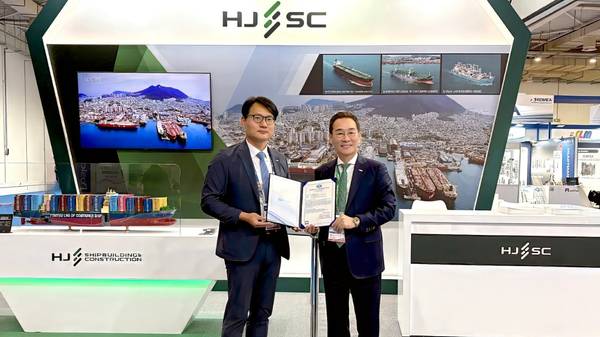
AiP award ceremony for a 10,000-teu biofuel-powered container ship. HJSC wins AiP for 10,000-teu biofuel-powered container ship design  

South Korean shipbuilder HJ Shipbuilding & Construction receives classification society approval for its biofuel vessel design at Posidonia.

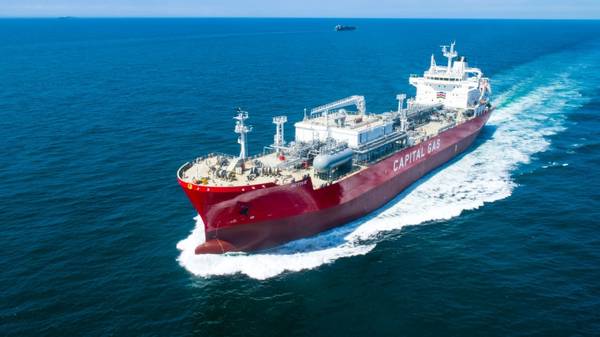
Active vessel. Capital Clean Energy Carriers takes delivery of LNG carrier and dual-fuel gas carrier, secures five new charters  

Athens-based CCEC expands its fleet and pushes contracted revenue backlog to $3.1bn.

VPS logo. Fuel quality management for vessels in extended idle: Arabian Gulf, Gulf of Oman and adjacent anchorages | Rahul Choudhuri, VPS  

Managing fuel quality deterioration following the closure of the Strait of Hormuz.

Person signing a document. Agastya Green Fuels signs 250,000 t/yr e-methanol offtake deal with Sri Lanka’s SAR Group  

Indian producer and Sri Lankan maritime firm agree long-term green methanol supply partnership.


↑  Back to Top