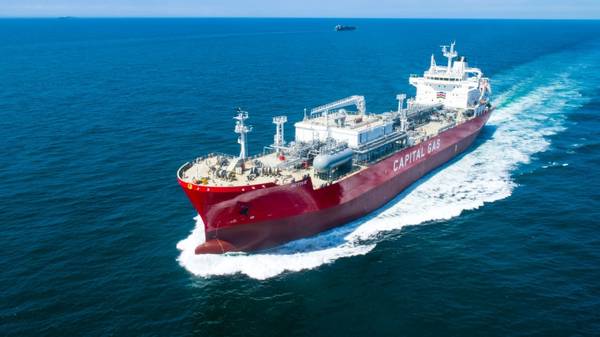
Source: ABB
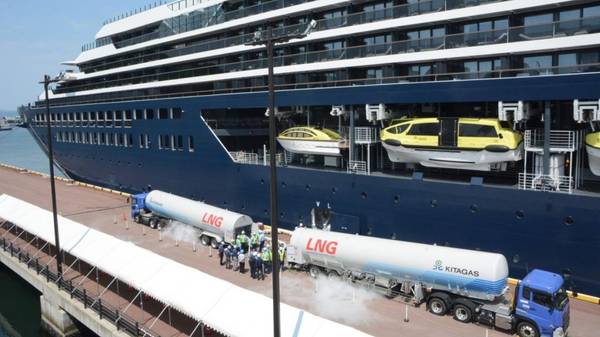
Liquefied natural gas, or LNG, is destined to become a key marine engine fuel in the future.
Traditionally merchant ships are fitted with diesel engines, most of them running on heavy fuel oil (HFO) rather than the more costly marine diesel oil (MDO). The next decade, however, could see a remarkable change in the fuel being used on ships. Dual fuel engines are, in fact, already in strong demand today.
Fuel represents roughly 60-70% of a ship’s operating costs. With the price of HFO steadily rising by 254% since 2001 and given the global economic downturn, ship owners have been forced to look for ways to reduce fuel consumption. Most large vessels are therefore currently being operated in 'slow steaming' mode, since lower speeds allow fuel consumption to be substantially reduced.
Besides higher prices there is another important factor that will play a role in the fuel used in the future for marine engines: the environment. The
International Maritime Organization (IMO) is implementing several measures aimed at restricting the shipping industry’s emissions. One of them is the
Energy Efficiency Design Index, due to become effective in 2013, that will indicate a ship’s CO2 emissions expressed in grammes per ton of cargo transported one nautical mile.
The case for LNG carriers
According to a study by
Det Norske Veritas AS (DNV), one of the most likely alternatives to diesel engines burning liquid fuel oil will be dual fuel engines running mainly on LNG and changing over to fuel oil only when required.
New engine designs have incorporated two turbochargers, arranged in series to generate increased air pressure, airflow and a superior turbocharging effect. This results in an efficiency rating of up to 76%, which is extremely high. The increased air pressure, combined with the advanced engine technology, improves the engine output and power density by up to 10%. At the same time, both fuel consumption and CO2 emissions are reduced.
Further emissions reduction can be achieved with additional engine systems or by the use of exhaust gas after-treatment. At high altitudes, 2-stage turbocharging technology guarantees the engine’s operational performance by compensating for the reduced air density. In addition, lower life cycle costs, compactness and cost effective design are all considered to be of importance. Calculations indicate that in certain power plant applications, the investment in advanced 2-stage engine technology could be regained in less than two years of operation.
The trend toward dual fuel engines is evident already today in the activity we are seeing in LNG carrier development. Although the propulsion system on these types of vessel were typically steam turbine based in the past, most of the vessels on order at the moment are 4-stroke duel fuel electric driven. The reasons are obvious: being able to run both diesel and gas, with higher efficiency and lower emissions, combine to make this solution a very attractive option for the future.