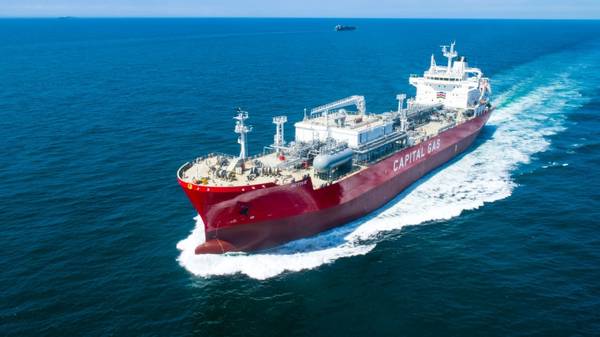
Dampskibsselskabet Norden A/S (D/S Norden) has revealed that one of its vessels, the medium-range (MR) product tanker
Nord Integrity [pictured], recently turned off its main engine for almost 300 nautical miles in order to save fuel.
According to D/S Norden, the incident took place during the last part of the ship's ballast voyage from
Sao Sebastiao in Brazil to
Skikda in Algeria. The vessel had so much time to spare after bunkering in
Las Palmas that
Captain Rohit Minocha, after consulting with the company's operations department at the main office in Hellerup, decided to stop the main engine and utilize nature's own and free forces as the only driving power.
During the following 3-4 days, the vessel then drifted 280 nautical miles (518 kilometres) towards the loading destination - by wind and sea current alone. This unusual initiative resulted in savings of 27 tonnes of fuel, corresponding to a total of USD 17,064 saved.
Just as importantly, the voyage fuelled by wind and current alone complied with all safety regulations, and the Nord Integrity reached the loading destination just in time and ready to load condensate for later discharge in
Rotterdam.
Head of NPP Operations,
Jens Malund Jensen, gave Captain Minocha much praise for his initiative: "This is a captain who is capable of thinking out of the box. Not everyone gets the idea to use nature’s own forces like that. After all, the merchant fleet of vessels switched to engine power several decades ago, so it requires innovative thinking to consider using wind and current as the only driving power. In addition, the captain has understood to use the local wind and current information optimally. Lots of fuel was saved – also of benefit to the environment, the voyage was safely performed, he reached the destination in time, he avoided to sit at anchor in the loading port, and he contributed to better safety at the loading port because the less crowded, the higher the safety. Everything and everyone benefited from his decision."
Jensen stressed that many factors must fall in place for that kind of sailing to be possible: "We must have plenty of time to reach the loading port, which we luckily rarely have. The wind and current must have the right direction. And finally, there must be enough room in the area to drift as safety can naturally never be compromised."
Jensen added that the unusual voyage between Las Palmas and Skikda was also the result of a good cooperation between the vessel and NPP’s Operations Department, and between Norden and the owner of the long-term chartered vessel.
"The cooperation has developed over several years and encourages the partners to have a close and open dialogue as well as being proactive and thinking out of the box," Norden said.
"The longer we continue down this track, the more good initiatives will also be presented to us. Optimisation of all voyages is crucial for our business. That is why I wish to share a success story as this one from Nord Integrity in the hope of a repeat, when time, wind, current, traffic in the area and the market make it possible again," remarked Jensen.
Jensen pointed out that a vessel carrying a cargo would never sail by wind and current alone. For laden vessels, the general principle for seaborne transports applies, i.e. 'utmost despatch' - meaning that the cargo must reach its destination as fast as possible.