The
European Maritime Safety Agency (EMSA) has published a document entitled: '
Overview and gaps of the regulatory framework for bunkering of gas-fuelled ships'.
Included in the document is a list of 43 items, which are divided into three main setions: 'onshore regulations', 'maritime regulations' and 'bunkering regulations'.
Of the 18 'bunkering regulations' in the list, only one - LNG fuel transfer systems, ISO 28460 EN 1474 - is currently regulated.
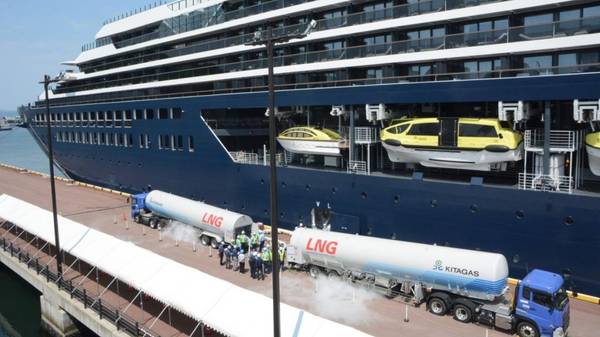
A list of the bunkering items and comments has been provided below.
* Definition of the LNG bunkering process - Guidelines under development. Not planned as international standard, yet.
* LNG bunkering procedures, STS - Guidelines under development. Not planned as international standard, yet.
* LNG bunkering procedures, TTS - Guidelines under development. Not planned as international standard, yet.
* LNG bunkering procedures, PTS - Guidelines under development. Not planned as international standard, yet.
* LNG bunkering procedures, Mobile tanks - Handling procedures for mobile tanks are not foreseen within the current rule development; neither in the IGF Code nor in the ISO TC 67 WG 10 Guidelines.
* LNG fuel transfer systems
* LNG ship to delivering facility interfaces - Functional requirements for the bunker interfaces are under development by ISO TC 67 WG 10.Design and operational requirements should be considered.
* LNG bunker port operations - Resulting from the "Study on Standards and Rules for bunkering gas fuelled ships" an extension of the scope of ISO 28460 could be possible to create a suitable Standard for bunkering LNG as fuel from Shore to ships. Decisions and activities regarding this recommendation are not started, yet. The International Association of Ports and Harbors
established own working groups defining requirements and guidelines for bunkering LNG within port areas. Finalising dates and application to International Standards are not foreseeable.
* LNG bunkering safety distances - Common safety distances are not defined. The current Draft of the ISO TC 67 WG 10 Guidelines contain a chapter "Calculation of safety distances". The approach should be cross checked with requirements of ISO 28460.
* LNG bunkering risk assessment and risk acceptance criteria - Within the ISO TC 67 WG 10 Guidelines a risk assessment approach and as well acceptance driteria are foreseen. The guidelines are not yet finalized.
* LNG bunkering during loading / unloading and passenger embarking / disembarking - Within the ISO TC 67 WG 10 Guidelines loading /
unloading and passenger embarking / disembarking processes are adressed to the risk assessment procedure. Detailed design requirements are not defined within the ISO TC 67 WG 10 guidelines and the draft IGF code.
* LNG bunker related Emergency Plans - Procedures are not defined and not in the scope of the current rule development.
* LNG fuel sampling - Procedures for sampling gas fuelled ships not defined and not in the scope of the current rule development.
* LNG fuel measurement - Procedures for LNG fuel management are not defined and not in the scope of the current rule development.
* LNG marine fuel quality - The specifications for LNG as fuel are not defined. Currently under discussion during the ISO TC 67 WG 10 work.
* LNG suplhur content - Procedures for the measurement of the sulphur content of LNG as fuel are not defined and not in the scope of the current rule development.
* Accreditation criteria LNG bunker company - Accrediation criteria for LNG bunker companies are not defined, yet.
* Environmental requirements - Basic statement to avoid the release of methane to atmosphere are stated but no pocedures are defined.
To view the EMSA document, please click on the following link:
Overview and gaps of the regulatory framework for bunkering of gas-fuelled ships